
Seeing Faces
of divided brains, Darwin, and duck-rabbits

What exactly am I going for here?
I’m not (quite) egotistical enough to imagine that legions of Buntzstack readers and Buntzcast listeners are sitting around puzzling over the enigmas of my personality or wondering how I would answer the question above. I know I don’t have a huge audience. One reads and runs, one listens and runs—as one should.
But I wanted to clarify some points for myself and for anyone who happens to still be scrolling through this. I recognize that readers might find what I’m doing suspicious. For example—why prove that Rudyard Kipling was a shaman, as I did in my last post, rather than the fully villainous imperialist figure many accuse him of being? I imagine some would find this politically suspect. Do I have rightwing motives?
In his 1946-1947 lectures, Ludwig Wittgenstein offered an account of his philosophical project, which provides a good summary of what I’m aiming for:
“In philosophy one feels forced to look at a concept in a certain way. What I do is suggest, or even invent, other ways of looking at it. I suggest possibilities of which you had not previously thought. You thought that there was one possibility, or only two at most. But I made you think of others. Furthermore, I made you see that it was absurd to expect the concept to conform to those narrow possibilities. Thus your mental cramp is relieved, and you are free to look around the field of use of the expression and to describe the different kinds of uses of it.”
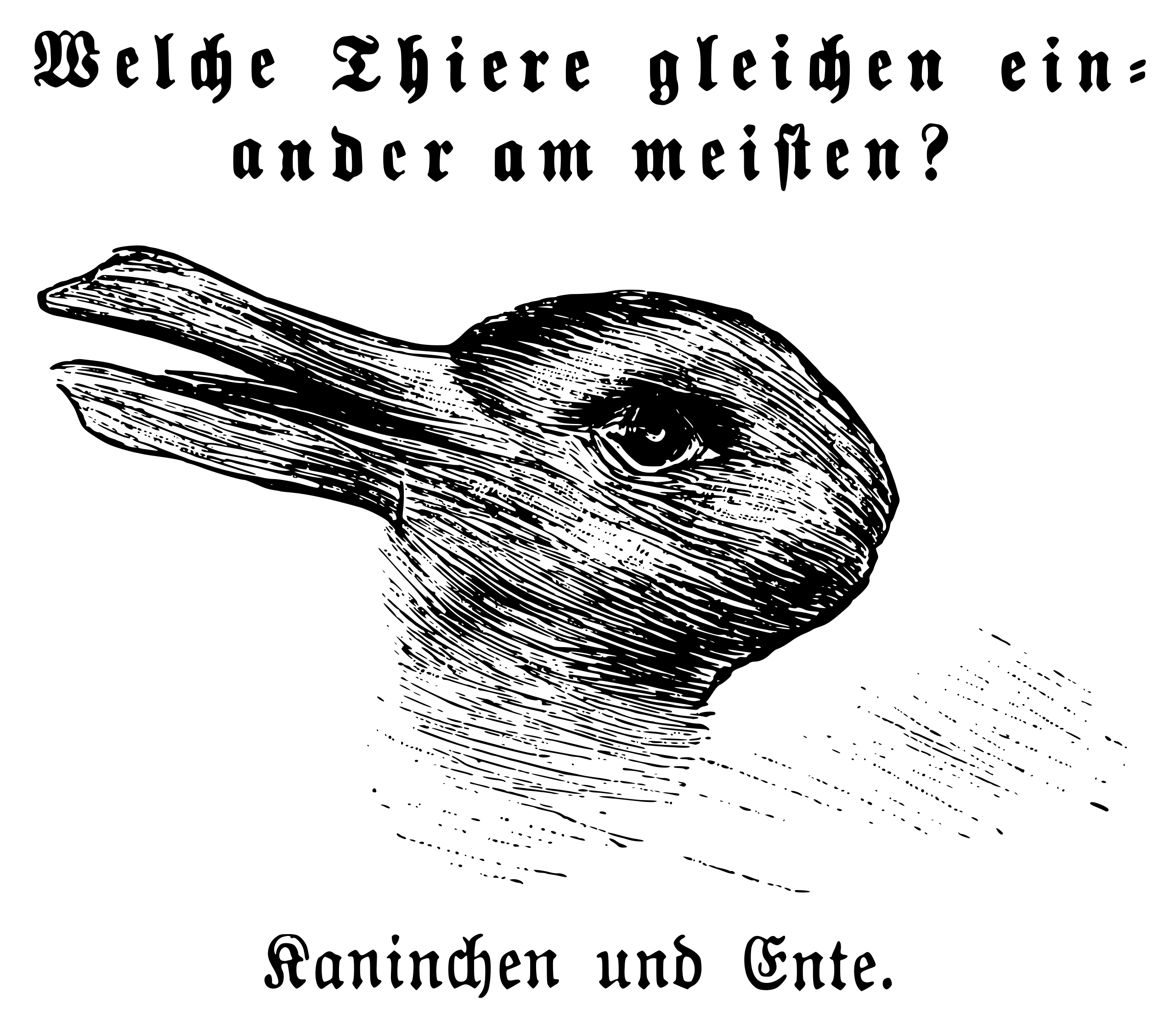
This is why I think it’s valuable to argue that Kipling was a shaman, rather than merely racist, sexist, etc. It is an effort at what Wittgenstein called “aspect-seeing”—seeing new faces of a phenomenon by changing the language we use to access it (“looking around the field of use of the expression”). You could read Edward Said’s essay on Kipling, which is respectful of Kipling’s literary skill but damning of his political motivations, and come away with one sense of the man. Then, you could read my essay and come away with a completely different sense. I’m not asking you to side with me or side with Said (since there is a lot of truth in Said). But I am asking you to entertain the notion that we might be offering completely different, yet relatively true, perspectives on the same person—like Wittgenstein’s duck-rabbit, which I mentioned and included in the Kipling essay and which is depicted above. The point is to reveal the many-sidedness of reality, to reveal dimensions of difference folded infinitely within one object. I picked a controversial writer specifically for that reason.
But why reveal the many-sidedness of reality when only a few sides have direct political value? My imaginary interlocutor wants to accuse me of muddying the water, which would have reactionary implications, since it impedes or distracts from political change. I see it differently.
I’ve been reading Iain McGilchrist’s study of right-brain and left-brain hemisphere differences, The Master and His Emissary (which I urge you to check out). McGilchrist shows that the popular understanding of left brain/right brain differences is false, while demonstrating convincingly and with voluminous evidence that there are serious and important differences between the two hemispheres.
To put it too briefly and broadly, the right hemisphere is attentive to the whole, while the left hemisphere is attentive to the part. The left hemisphere assembles a lingual map of reality, a taxonomy of parts, that ends up imprisoning our consciousness—it can’t shift its frame to consider new aspects of reality. As Robert Graves once put it, “There is a cool web of language that draws us in.”
Only the right brain can follow a melody or get a joke, because the left hemisphere is locked into the analysis of parts. Humor and music are just two examples of how seeing or hearing the whole is necessary to “get it.” We can’t listen to music by hearing each note only as a discrete entity. As McGilchrist puts it, we need to hear the “betweenness” of the notes—how they connect and flow together—to let them speak to us. This is a great metaphor for how to engage with life, and it connects to the ethical center of Wittgenstein’s project (which many people don’t realize has an ethical center).
Our malady, at present, is that we habitually latch on to one aspect of reality and obsess over it, map it, and dissect it, while ignoring the other aspects. According to McGilchrist, our culture rewards and flatters left hemisphere dominance. This has reverberations through every aspect of life, including its political dimensions. To give an example of a rightwing pathology: racism is a left hemispheric delusion, the constant obsessive indexing of human taxonomy. Christopher Hitchens once observed that it’s a shame that the word “discrimination” became associated with racial prejudice because discrimination is precisely the thing a racist can’t do. The right brain can perceive the unique individual as a whole, but the left brain can’t and so lets one aspect of reality (like skin color) tyrannize over its understanding.
At the same time, Freud, Marx, and Foucault provide sophisticated reductionisms that lock the left hemisphere into similar modes of obsessively characterizing reality, except with a leftist valence (“it’s all sex,” “it’s all economics,” “it’s all power,” etc.), which fit snugly alongside “it’s all race” or, to give a religious example, “it’s all demons.”
Furthermore, many scientists have their own left hemispheric reductionism. (This is the most obvious variety noted thus far and a particular target of Wittgenstein’s ire.) To give a comical example: Richard Dawkins is knowledgeable when it comes to genes but managed to dramatically swing and miss when it came to interpreting Kafka’s “The Metamorphosis”:
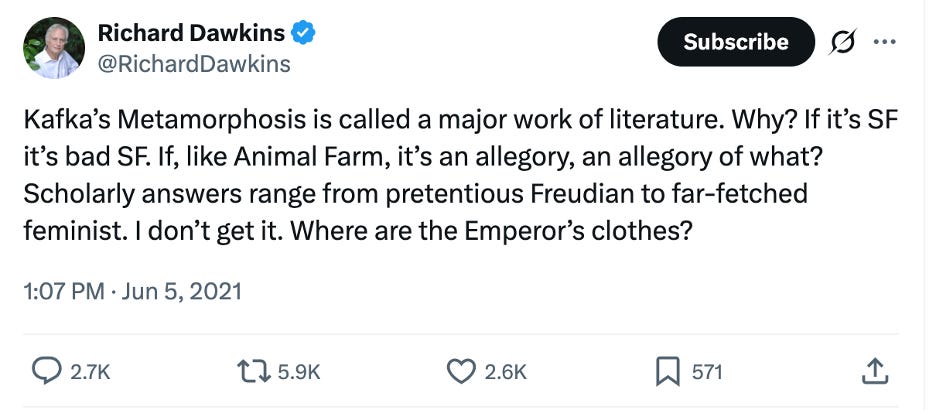
I find the innocence of Dawkin’s query endearing. What makes “The Metamorphosis” great is precisely that it is multivocal, that it evokes a world of possible interpretations. We can reach a deeper understanding of the story not through one interpretation alone but by placing an array of interpretations in synchrony and tension. But Dawkins, being so left hemispheric, wants it to mean only one thing. This is mental tyranny.
By his own account, a similar intellectual blindness afflicted Charles Darwin, who was more self-aware than Dawkins. This confessional passage from Darwin’s Autobiography is fascinating:
I have said that in one respect my mind has changed during the last twenty or thirty years. Up to the age of thirty, or beyond it, poetry of many kinds, such as the works of Milton, Gray, Byron, Wordsworth, Coleridge, and Shelley, gave me great pleasure, and even as a schoolboy I took intense delight in Shakespeare, especially in the historical plays. I have also said that formerly pictures gave me considerable, and music very great delight. But now for many years I cannot endure to read a line of poetry: I have tried lately to read Shakespeare, and found it so intolerably dull that it nauseated me. I have also almost lost my taste for pictures or music. Music generally sets me thinking too energetically on what I have been at work on, instead of giving me pleasure. I retain some taste for fine scenery, but it does not cause me the exquisite delight which it formerly did.
[…] This curious and lamentable loss of the higher aesthetic tastes is all the odder, as books on history, biographies, and travels (independently of any scientific facts which they may contain), and essays on all sorts of subjects interest me as much as ever they did. My mind seems to have become a kind of machine for grinding general laws out of large collections of facts, but why this should have caused the atrophy of that part of the brain alone, on which the higher tastes depend, I cannot conceive. A man with a mind more highly organised or better constituted than mine, would not, I suppose, have thus suffered; and if I had to live my life again, I would have made a rule to read some poetry and listen to some music at least once every week; for perhaps the parts of my brain now atrophied would thus have been kept active through use. The loss of these tastes is a loss of happiness, and may possibly be injurious to the intellect, and more probably to the moral character, by enfeebling the emotional part of our nature.
I find this to be a touching confession. (Darwin does note that he can still appreciate novels, perhaps because prose often lends itself more readily to left-brained analysis than poetry). We can contrast Darwin’s humility and self-scrutiny with Dawkins’ unwarranted self-confidence. McGilchrist argues that the parts of the brain we prioritize really have been shown to take over more of its work. It seems that Darwin, by privileging his left hemisphere—a “machine for grinding general laws out of large collections of facts”—quite possibly atrophied his right hemisphere.
Darwin’s self-assessment functions as an oddly accurate assessment of what has happened to our culture as a whole, particularly now that we are ruled by tech barons. It shows that the left-brain habits we cultivate—through education, work, science, legalistic schools of theological thought, and so on—do result in fundamental changes to our consciousness, dimming our capacity for higher levels of aesthetic appreciation. The tech barons assume that nothing is lost thereby. But you, insofar as you can respond to aesthetic power, know that something infinitely precious is being lost.
We are all imprisoned by our maps, by the grid the left hemisphere imposes on the world. But there are therapeutic means of escape. I suggest that we turn to Goethe, Rudolf Steiner, the American Transcendentalists, Wittgenstein, Heidegger, and, of course, the vast heritage of classic poetry and poetic prose, to resuscitate the right hemisphere. All offer a path back to seeing the whole (with its many sides) and being attentive to what it has to tell us. Goethe even pioneered scientific techniques that involve learning to see the whole, which have been underappreciated.
From a theological point of view, you could say that left-brain reductionisms are all subsets of idolatry. They are determined to convince us to worship a human lingual creation, a map, a figure, as a final theory of reality. They all insist on a false unity, a single dimension of Being, and ask us to bow before it. We cut the living fact into dead portions and select one as deity.
But there is a way of reconciling unity and multiplicity. It is to learn to see that the different faces existence presents to us are all means of approaching one underlying reality that can’t be defined through language but can be hinted at or evoked through it. As Joseph Campbell put it in the conclusion of The Hero with a Thousand Faces, “The way to become human is to learn to recognize the lineaments of God in all the wonderful modulations of the face of man.”
Why do you say "racism is a left hemispheric delusion, the constant obsessive indexing of human taxonomy?"
Humans are attracted to, or at least identify with, other humans who look and act like them. It's no more obsessive than sight or touch or hearing.
If anyone obsessively indexes (and exploits) race and sex differences it's liberals. Have you not seen or heard of the African-American Museum of History and Culture, on the Mall next to the Washington Monument?
IMO, effective and reliable pattern recognition ability is the defining trait of high “IQ” (whatever that means). This would seem to me to be a unification of the left and right hemispheres (left to identify and classify the discrete items of information, right to amalgamate them and discover a combinatory resolution).